Quantum Batteries Market Size, Share & Industry Analysis, By Technology Type (Solid-State Quantum Batteries, Quantum Dot-Based Batteries, Supercapacitor-Integrated Quantum Systems, Photonic Quantum Batteries, and Others), By Material (Graphene-Based Materials, Quantum Dots, Perovskite Materials, Metal Oxides & Advanced Nanomaterials, and Others), By Application (Consumer Electronics, IoT & Sensors, Electric Vehicles (EVs), Renewable Energy Storage Systems, Medical Devices & Implants, and Others), Regional Forecast, 2026-2034
 Download Free Sample
 Quantum Batteries Market Size and Future Outlook
 Listen to Audio Version
The global quantum batteries market size was valued at USD 120.33 million in 2025. The market is projected to grow from USD 206.67 million in 2026 to USD 900.23 million by 2034, exhibiting a CAGR of 20.19% during the forecast period.
Quantum batteries are energy storage systems that leverage quantum technology, which includes mechanical phenomena such as superposition, entanglement, and collective charging to store and release energy more efficiently than classical electrochemical batteries. Unlike conventional batteries that rely on ion transport and chemical reactions, quantum batteries utilize engineered quantum states in nanoscale materials (e.g., quantum dots, spin systems, or photonic structures) to enable ultra-fast charging and reduced energy losses. Recent laboratory studies have demonstrated that collective quantum interactions can significantly enhance charging power, making them attractive for next-generation electronics.
Key drivers for the technology include advancements in quantum mechanics and nanofabrication techniques, which enable controlled manipulation of energy states at the atomic scale. Increasing investment in quantum technologies and high-performance computing ecosystems is accelerating foundational research, thereby driving market growth. Additionally, increasing demand for instant charging, miniaturized energy storage, and high-efficiency systems in IoT devices, medical implants, and future electronics is pushing exploration of non-chemical storage mechanisms. Quantum batteries represent an emerging energy storage technology that leverages quantum mechanical effects to achieve exceptionally high energy density and ultra-fast charging capabilities, offering potential breakthroughs for next-generation electronic and power applications.
- For instance, in March 2026, researchers at RMIT University (Australia) reported the development of a lab-scale quantum battery technology prototype that utilized light-induced excitation in nanoscale materials to store energy. The study demonstrated improved energy absorption efficiency compared to classical systems, marking a transition from theoretical models to experimental validation and highlighting the feasibility of integrating quantum energy storage concepts into future electronic devices.
Some of the leading companies operating in the industry include Avantama AG, Nanoco Group PLC, Nncrystal US Corp., Quantum Materials Corp., and others. Avantama AG is a Switzerland-based nanotechnology company specializing in quantum dots and advanced materials for optoelectronic applications. Its innovations in high-performance nanomaterials support emerging technologies such as next-generation displays, photovoltaics, and potentially quantum battery systems through enhanced energy absorption and transfer capabilities.
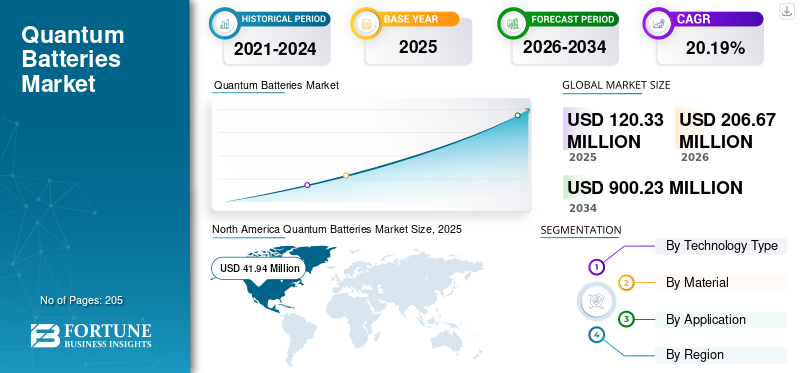
Download Free sample to learn more about this report.
QUANTUM BATTERIES MARKET TRENDS
Advancements in Quantum Charging Mechanisms and Material Engineering are the Key Market Trends
The quantum batteries market is witnessing a shift toward collective charging architectures, where multiple quantum units interact to achieve significantly higher charging power compared to isolated systems. Research is increasingly focused on superabsorption and entanglement-driven charging, enabling faster energy uptake without proportional energy loss. In parallel, material innovation is accelerating, particularly in quantum dots, perovskites, and graphene-based nanostructures, which allow precise control over energy states and improved stability at nanoscale levels.
Another key trend is the integration of photonic systems, where light-induced excitation is used for energy storage, aligning with developments in optoelectronics and semiconductor platforms. Additionally, there is growing emphasis on hybrid quantum-classical architectures, aiming to bridge the gap between theoretical models and practical deployment by enhancing compatibility with existing electronic systems.
MARKET DYNAMICS
MARKET DRIVERS
Download Free sample to learn more about this report.
Rising Investment in Quantum Technologies and Demand for Ultra-Fast Energy Storage Systems to Drive Market Growth
The growth of the market is primarily driven by increasing global investment in quantum technologies and advanced materials research, which is accelerating the transition from theoretical models to experimental prototypes. Governments and institutions are actively funding quantum research programs; for instance, the U.S. Department of Energy’s Quantum Information Science initiatives and the EU Quantum Flagship program support studies on quantum energy systems and materials. Additionally, breakthroughs such as the work conducted by the University of Adelaide and the University of St Andrews in 2022 on collective quantum charging have demonstrated that quantum interactions can significantly enhance charging speed, reinforcing practical viability.
In addition, the rising demand for instant charging and miniaturized energy storage solutions in applications such as IoT devices, medical implants, and next-generation electronics, where conventional batteries face limitations, is gaining popularity. Furthermore, advancements in nanomaterials such as quantum dots and graphene, developed by companies such as Nanoco Group and Avantama AG, are enabling controlled energy storage at atomic scales. These developments collectively push quantum batteries toward future commercialization by addressing efficiency, speed, and scalability challenges.
MARKET RESTRAINTS
Technical Complexity and Lack of Standardized Manufacturing Processes for Producing Quantum Materials Hamper Market Demand
The development of the product is constrained by significant technical complexity and challenges in translating theoretical models into practical, scalable systems. Unlike conventional batteries, quantum batteries rely on maintaining quantum coherence and controlled interactions at nanoscale levels, which are highly sensitive to environmental disturbances such as temperature fluctuations and noise. Current experimental demonstrations, such as spin-based and photonic quantum systems, are largely confined to laboratory conditions, limiting their real-world applicability.
Furthermore, there is a lack of standardized manufacturing processes for producing quantum materials such as quantum dots and engineered nanostructures at scale with consistent performance. Integration with existing electronic and energy storage systems also remains a hurdle, as quantum architectures require specialized interfaces and control mechanisms.
MARKET OPPORTUNITIES
Emergence of Photonic and Nano-Engineered Energy Storage Platforms to Create Market Opportunities
The present significant opportunities through the convergence of photonic systems and nano-engineered materials, enabling entirely new approaches to energy storage beyond electrochemical limits. One major opportunity lies in light-driven (photonic) quantum batteries, where energy is stored using controlled light-matter interactions. For instance, research by the Italian National Research Council and the University of Milan conducted during 2020–2023 demonstrated enhanced energy absorption via quantum superabsorption, opening pathways for ultra-fast charging devices.
Another key opportunity lies in integration with next-generation electronics and quantum computing systems, where compact, high-speed energy storage is essential for performance optimization. Furthermore, the growing push toward self-powered IoT devices and autonomous sensors creates demand for miniaturized, maintenance-free energy solutions. These developments position the product as a transformative technology for applications requiring rapid charging, high performance, and seamless integration with advanced electronic platforms.
MARKET CHALLENGES
Limited Experimental Validation and Uncertain Commercial Viability Deter Industry Expansion
A major challenge in the quantum batteries market growth is the gap between theoretical potential and experimental validation, which creates uncertainty around real-world performance and commercialization timelines. While concepts such as collective charging and quantum superabsorption have been demonstrated in controlled settings, most results remain confined to highly specialized laboratory environments.
For example, experimental studies by institutions such as the University of Tokyo and RMIT University have shown promising energy storage behaviors, but these systems operate under precise conditions that are difficult to replicate at scale. Additionally, there is limited understanding of how the product will perform over extended cycles, stability periods, and real-world operating conditions, which are critical for practical deployment.
Segmentation Analysis
By Technology Type
Solid-State Quantum Batteries Segment Dominated due to their Inherent Structural Stability
Based on technology type, the market is classified into solid-state quantum batteries, quantum dot-based batteries, supercapacitor-integrated quantum systems, photonic quantum batteries, and others.
In 2025, the solid-state quantum batteries dominated the market due to their inherent structural stability and compatibility with established solid-state and semiconductor technologies. Unlike other experimental architectures, solid-state designs leverage well-understood material platforms, enabling easier integration with existing electronic systems and fabrication processes. Their ability to maintain controlled quantum states with reduced environmental interference enhances reliability in experimental conditions. Additionally, advancements in solid-state nanomaterials and thin-film technologies support scalable prototype development.
The photonic quantum batteries segment is expected to grow at a CAGR of 22.34% during the study period.
To know how our report can help streamline your business, Speak to Analyst
By Material
Graphene-Based Materials Segment Dominated Due to Their Exceptional Electrical Conductivity
Based on material, the market is classified into graphene-based materials, quantum dots, perovskite materials, metal oxides & advanced nanomaterials, and others.
In 2025, the graphene-based materials segment dominated the global market due to their exceptional electrical conductivity, high surface area, and ability to support tunable quantum states, making them highly suitable for quantum energy storage applications. Their two-dimensional structure enables efficient charge transport and minimal energy loss, which is critical for enhancing quantum charging efficiency. Additionally, graphene can be engineered at the nanoscale to interact with quantum dots and photonic systems, supporting advanced battery architectures.
The perovskite materials segment is expected to grow at a CAGR of 21.79% during the study period.
By Application
Consumer Electronics is dominant due to the High Demand for Ultra-Fast Charging Energy Storage Solutions
On the basis of application, the market is classified into consumer electronics, IoT & sensors, electric vehicles (EVs), renewable energy storage systems, medical devices & implants, and others.
In 2025, the consumer electronics segment dominated the global market due to the immediate need for compact, high-efficiency, and ultra-fast charging energy storage solutions in devices such as smartphones, wearables, and portable electronics. Quantum batteries align well with these requirements as they offer potential for rapid charging and miniaturization at nanoscale levels, unlike conventional batteries, limited by chemical processes.
The electric vehicles (EVs) segment is expected to grow at a CAGR of 22.62% during the study period.
Quantum Batteries Market Regional Outlook
By geography, the market is categorized into North America, Europe, Asia Pacific, Latin America, and the Middle East & Africa.
North America
North America Quantum Batteries Market Size, 2025 (USD Million)
To get more information on the regional analysis of this market, Download Free sample
North America held the highest quantum batteries market share in 2025, valued at USD 41.94 million, and continues to maintain its significant share in 2026, reaching USD 71.85 million. The regional market growth is due to its strong ecosystem of quantum research, advanced materials development, and government-backed funding programs. The region benefits from significant investments by agencies such as the U.S. Department of Energy (DOE) and the National Science Foundation (NSF), which support quantum energy and nanotechnology research. Leading institutions such as MIT, Harvard, and national laboratories are actively working on quantum energy storage concepts, accelerating innovation.
U.S. Quantum Batteries Market
Based on North America’s strong contribution and the U.S. dominance within the region, the U.S. market stood at around USD 35.72 million in 2025, accounting for roughly 29.68% of the global market sales.
Europe
Europe is projected to record a growth rate of 20.62% in the coming years, which is the second-highest among all regions, with the market valued at USD 33.19 million in 2025. The region represents the key contributor to market development, driven by coordinated, multi-country research frameworks and strong materials science expertise. The EU Quantum Flagship program, launched in October 2018, enables collaboration between institutions such as Fraunhofer (Germany), CNRS (France), and TU Delft (Netherlands), focusing on quantum coherence and photonic energy systems. The region’s strength lies in precision nanofabrication and applied research, allowing practical experimentation with quantum energy storage concepts.
Germany Quantum Batteries Market
The market in 2025 reached around USD 8.91 million 2025 and is estimated to touch around USD 15.55 million by 2026, representing roughly 7.40% of the global revenues. The country leverages its strong semiconductor and automotive ecosystem to explore the integration of advanced energy storage into next-generation electronics and mobility solutions. Collaborative projects under the EU Quantum Flagship further position Germany as a hub for translating quantum energy concepts into scalable engineering applications.
Asia Pacific
Asia Pacific reached USD 30.70 million in 2025, securing the third-largest share of the market. The region’s market development is driven by China’s state-backed quantum programs and strong nanomaterial manufacturing capabilities, enabling rapid experimentation with scalable materials such as quantum dots. Japan contributes through precision material science and quantum thermodynamics research, particularly in institutions such as the University of Tokyo, focusing on energy efficiency at atomic scales.
India Quantum Batteries Market
The market in India stood at around USD 2.80 million in 2025, accounting for roughly 2.32% of global revenues. India’s progress is driven by government-backed initiatives such as the National Quantum Mission, supporting research in quantum materials and energy systems.
China Quantum Batteries Market
China’s market is projected to be significant worldwide during the study period, with 2025 revenues standing at around USD 10.59 million, representing roughly 8.80% of the global market.
Japan Quantum Batteries Market
The Japanese market in 2025 stood at around USD 6.23 million, accounting for roughly 7.67% of global revenues.
Latin America
The Latin America market reached a valuation of USD 5.27 million in 2025 and is expected to witness moderate growth in this market during the forecast period. Region’s quantum battery activity is concentrated in Brazil and Mexico, where universities are advancing quantum materials and nanotechnology research linked to energy applications.
Brazil Quantum Batteries Market
Brazil's market reached around USD 2.47 million in 2025, representing roughly 2.05% of the global market.
Middle East & Africa
The Middle East & Africa market reached a valuation of USD 9.24 million in 2025 and is expected to witness significant growth in this market during the forecast period. The region is emerging through GCC-led investments in advanced research hubs such as KAUST and the UAE’s technology institutes, focusing on nanomaterials and quantum systems.
GCC Quantum Batteries Market
The GCC market reached around USD 4.48 million in 2025, representing roughly 3.72% of the global market.
COMPETITIVE LANDSCAPE
Key Industry Players
Major players are Focusing on Expanding their Product Portfolio to Improve Energy Absorption
The global quantum batteries market holds a consolidated market structure, constituting prominent players such as Avantama AG, Nanoco Group PLC, Nncrystal US Corp., and others. Companies operating in the market are adopting targeted growth strategies focused on strengthening their product portfolio, technological advancements, expanding manufacturing presence, and other areas.
- For instance, in June 2023, Avantama AG expanded its portfolio of perovskite and quantum dot batteries for optoelectronic applications, focusing on improving energy absorption and charge transfer efficiency at the nanoscale levels. The company collaborated with research institutes to develop high-performance nanomaterial formulations that can support light-driven energy storage concepts. These advancements are relevant for quantum battery architectures, particularly photonic systems, where precise control of material properties is critical for efficient energy capture and storage.
Other key market players in the global market include Quantum Materials Corp., Qustomdot B.V., UBIQD, and Alphabet Inc. (Google Inc.). These companies are expected to prioritize new product launches and collaborations to increase their global market share during the forecast period.
LIST OF KEY QUANTUM BATTERIES COMPANIES PROFILED
- Avantama AG (Switzerland)
- Nanoco Group PLC (U.K.)
- Nncrystal US Corp. (U.S.)
- Quantum Materials Corp. (U.S.)
- Qustomdot B.V. (Netherlands)
- UBIQD (U.S.)
- Alphabet Inc. (Google Inc.) (U.S.)
- Shoei Electronic Materials Inc. (Japan)
- Quantum Instruments (U.S.)
- CD Bioparticles (U.S.)
KEY INDUSTRY DEVELOPMENTS
- October 2023: Alphabet, through Google Quantum AI, continued research into quantum system control and coherence, which are fundamental for quantum energy storage concepts. The company’s work on quantum simulations and material behavior at atomic scales provides insights into how energy can be stored and transferred using quantum states. While not directly developing batteries, these advancements support the theoretical and computational foundation required for future quantum battery architectures.
- March 2023: Nncrystal US Corp. enhanced its production capabilities for high-quality quantum dots tailored for advanced electronic and photonic applications. The company emphasized improving the uniformity and stability of nanocrystals, which are essential for consistent energy storage behavior in quantum systems. These materials are increasingly relevant for experimental quantum battery designs, where controlled nanoscale interactions are required to achieve efficient energy absorption and rapid charging performance.
- September 2022: Nanoco Group PLC advanced its cadmium-free quantum dot technology for use in next-generation electronic and energy applications. The company focused on enhancing the optical and electronic properties of nanomaterials, enabling efficient light absorption and energy transfer mechanisms. These developments support emerging quantum battery concepts, particularly in photonic charging systems, where quantum dots play a key role in nanoscale energy storage and controlled excitation processes.
- July 2022: Shoei Electronic Materials Inc. expanded its development of advanced electronic materials and semiconductor-related compounds, focusing on improving performance for high-precision applications. The company worked on enhancing material purity and stability, which are essential for nanoscale and quantum-level energy systems. These materials can support emerging quantum battery technologies by enabling better control over electronic and quantum interactions in advanced energy storage devices.
- January 2021: Quantum Materials Corp. focused on scaling its quantum dot manufacturing platform, aiming to deliver low-cost, high-performance nanomaterials for energy and electronics applications. The company worked on improving charge transport and optical efficiency of its materials, which are critical parameters for quantum energy storage systems. These efforts support the foundational material requirements for quantum batteries, particularly in architectures relying on nanoscale energy transfer and photonic interactions.
REPORT COVERAGE
The global quantum batteries market analysis provides an in-depth study of the market size & forecast by all the market segments included in the report. It includes details on the market dynamics and market trends that are expected to drive the market in the forecast period. It offers information on the technological advancements, new product launches, key industry developments, and details on partnerships, mergers & acquisitions. The market research report also encompasses a detailed competitive landscape with information on the market share and profiles of key operating players.
Request for Customization to gain extensive market insights.
Report Scope & Segmentation
| ATTRIBUTE | DETAILS |
| Study Period | 2021-2034 |
| Base Year | 2025 |
| Estimated Year | 2026 |
| Forecast Period | 2026-2034 |
| Historical Period | 2021-2024 |
| Growth Rate | CAGR of c% from 2026 to 2034 |
| Unit | Value (USD Million) |
| Segmentation | By Technology Type, Material, Application, and Region |
| By Technology Type |
|
| By Material |
|
| By Application |
|
| By Geography |
|
Frequently Asked Questions
Fortune Business Insights says that the global market value stood at USD 120.33 million in 2025 and is projected to reach USD 900.23 million by 2034.
In 2025, the Asia Pacific market value stood at USD 30.70 million.
The market is expected to exhibit a CAGR of 20.19% during the forecast period.
The solid-state quantum batteries segment led the market by technology type.
Increasing investment in quantum technologies and demand for ultra-fast energy storage systems are the key factors driving the market.
Avantama AG, Nanoco Group PLC, and Nncrystal US Corp. are some of the top players in the market.
North America dominated the market in 2025.



- 2021-2034
- 2025
- 2021-2024
- 205
Get 20% Free Customization
Expand Regional and Country Coverage, Segments Analysis, Company Profiles, Competitive Benchmarking, and End-user Insights.



















Related Reports
-
US +1 833 909 2966 ( Toll Free )
-
Get In Touch With Us