Circuit Tracer Market Size, Share & Industry Analysis, By Type (Wire Tracers, Circuit Breaker Finders, Underground Cable Tracers, Tone Generator and Probe Kits, and Advanced Digital Circuit Tracers), By Technology (Analog Circuit Tracers, Digital Circuit Tracers, and Wireless/Non-Contact Circuit Tracers), By End-Use Industry (Construction and Real Estate, Electrical and Maintenance Services, Industrial Manufacturing, Utilities, Telecommunications, and Oil and Gas/Energy Infrastructure), and Regional Forecast, 2026-2034
 Download Free Sample
 Circuit Tracer Market Size and Future Outlook
 Listen to Audio Version
The global circuit tracer market size was valued at USD 840.00 million in 2025. The market is projected to grow from USD 903.89 million in 2026 to USD 1,551.26 million by 2034, exhibiting a CAGR of 6.98% during the forecast period. North America dominated the circuit tracer market with a market share of 38.09% in 2025.
An electrical circuit tracer is a device used to track and identify electrical wiring, circuits, and breakers within an electrical system without requiring direct visual inspection of the wires. It works by sending a signal through a circuit and using a receiver to detect that signal, helping users locate wires, find the correct breaker, or identify faults quickly and safely.
The growing need for effective electrical maintenance and troubleshooting tools across residential, commercial, and industrial sectors is driving market expansion. The need for precise circuit identification and fault-detection equipment has grown significantly as electrical systems have become more complex through the integration of renewable energy systems, smart technologies, and cutting-edge infrastructure. Additionally, the product adoption for secure, efficient installations is being driven by rapid urbanization and construction activities, particularly in developing regions. The increasing emphasis on reducing downtime during electrical repairs, along with strict safety requirements, is also driving the use of non-invasive diagnostic equipment, thereby expanding the market during the forecast period.
Due to their extensive knowledge of electrical testing and measurement solutions and their well-established presence worldwide, key suppliers in the industry include Klein Tools, Amprobe, and Fluke Corporation. These firms offer a wide selection of reliable, high-accuracy circuit tracing tools for industrial technicians, maintenance workers, and professional electricians. Their products are widely used in construction, utilities, and industry due to their reputation for reliability, precision, and compliance with safety regulations.
For instance, in July 2025, IDEAL Electrical revealed the introduction of its SureTrace Circuit Tracer Pro, a next-generation diagnostic instrument created to improve the speed, precision, and ease of troubleshooting electrical issues. Among the device's cutting-edge capabilities are an inductive-sensing clamp for non-contact tracing and amperage measurement, dual rotating OLED displays, and an integrated continuity tester.
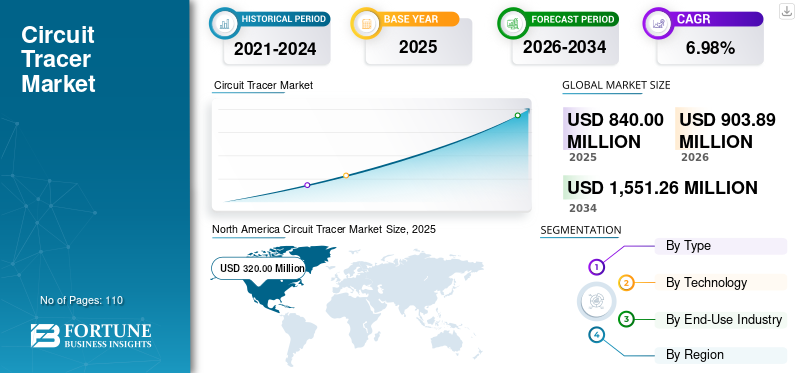
Download Free sample to learn more about this report.
CIRCUIT TRACER MARKET TRENDS
Increasing Demand from Industrial Manufacturing and Utilities Sector to Drive Market Growth
The expansion of the industry is driven by rising demand from industrial manufacturing and utilities, which are heavily dependent on sophisticated electrical systems for uninterrupted operations. To reduce downtime and prevent expensive interruptions in manufacturing plants, accurate circuit identification tools are necessary for routine maintenance, fault detection, and effective troubleshooting of equipment and production lines. Circuit tracers are similarly used by utilities, such as electricity generation, transmission, and distribution networks, to identify faults, trace cabling, and maintain system reliability. The use of the product is increasing as these industries continue to grow and modernize through automation and sophisticated electrical infrastructure to improve operational efficiency, safety, and maintenance accuracy.
In May 2022, Klein Tools launched a new Advanced Circuit Tracer Kit. It comprises a transmitter, receiver, blade, and ground prongs, alligator clips, 3-foot and 20-foot lead adapters, AC plug leads, instructions, all required batteries, and a hard-carrying case with a handle for convenient transportation and storage. This new package provides professionals with all the tools they need to quickly trace live and dead breakers, fuses, and cables through drywall, concrete, and even underground. The solution is particularly beneficial for industrial manufacturing and utilities sectors, where complex electrical networks require accurate circuit identification and fault detection to ensure operational efficiency, minimize downtime, and maintain safety across large-scale production facilities and power distribution systems.
MARKET DYNAMICS
MARKET DRIVERS
Technological Advancements in Non-Invasive and Digital Circuit Tracing Devices to Drive Market Growth
Technological advancements in non-invasive, digital circuit-tracing devices are significantly driving the circuit tracer market growth, enabling faster, safer, and more accurate diagnostics without disrupting existing electrical systems. Modern circuit tracers equipped with digital signal processing, enhanced sensitivity, and non-contact detection capabilities allow technicians to trace wires through walls, underground, and in complex infrastructures without physical access. These innovations reduce the risk of electrical hazards and minimize operational downtime, making them highly suitable for industrial, commercial, and utility applications.
In December 2025, AEMC Instruments launched the NEW Cable Verification & Tracing Analyzer Model 6683. The NEW Cable Verification & Tracing Analyzer Model 6683 can rapidly locate, identify, and diagnose electrical cables and metal pipes, even when buried or concealed behind walls. Its transmitter-receiver system ensures quick, reliable problem-solving by combining precise detection, safety, and digital clarity. The product reflects significant technological advancements in circuit tracing, particularly through enhanced digital signal processing, improved detection accuracy, and non-invasive diagnostics, enabling technicians to perform efficient, safe troubleshooting in complex electrical environments.
Download Free sample to learn more about this report.
MARKET RESTRAINTS
High Cost of the Product to Restrain Market Growth
The high cost of advanced circuit tracers is a key restraint on the market, as it limits adoption among small- and medium-sized contractors and independent electricians. Modern circuit tracers equipped with digital displays, non-invasive detection, and multi-functional diagnostic features are typically priced at a premium, making them less affordable for cost-sensitive users. In many cases, end users continue to rely on conventional, lower-cost testing tools that perform basic functions, reducing demand for advanced solutions. Additionally, the high initial investment, along with maintenance and calibration costs, can discourage widespread adoption, particularly in developing regions, thereby slowing overall market growth.
MARKET OPPORTUNITIES
Increase in Renewable Energy Installations to Drive Market Growth
The industry is expanding as the number of renewable energy installations rises, as solar, wind, and other clean energy systems rely on intricate electrical grids for optimal performance and maintenance. These systems require intricate grid connections, inverters, and wiring that must be carefully installed and routinely monitored to ensure optimal performance and safety. Particularly in large solar farms and wind power plants, the product is essential for determining wiring routes, locating faults, and confirming connections in renewable energy systems. The need for sophisticated diagnostic equipment, such as circuit tracers, is growing alongside global investments in renewable energy to ensure dependable operation, minimize downtime, and maximize system efficiency.
For instance, in May 2025, Nextracker, a world leader in cutting-edge solar energy solutions, announced that it had deployed more than 10 gigawatts (GW) of solar trackers across India, marking a significant milestone that strengthens its market position and supports the country’s expanding solar energy adoption. To support this expansion, the company opened its new 80,000-square-foot office and research and development (R&D) center in Hyderabad, demonstrating its long-term dedication to serving clients across the region and fostering India's clean energy future. The demand for sophisticated electrical diagnostic equipment is also rising as large-scale solar infrastructure projects continue to expand. These instruments are crucial for fault identification, wiring verification, and efficient installation in complex solar power systems, ensuring operational reliability and reducing system downtime.
MARKET CHALLENGES
Limited Awareness and Adoption in Developing Regions to Hamper Market Growth
Limited awareness and adoption in developing regions hamper market growth, as many end users, including small contractors and electricians, continue to rely on traditional, low-cost electrical testing methods. In these regions, there is often limited exposure to advanced diagnostic tools and insufficient training on their benefits and use, which reduces the willingness to invest in modern circuit tracers. Additionally, budget constraints and prioritization of basic infrastructure over advanced tools further restrict adoption. As a result, despite the availability of efficient, time-saving circuit-tracing technologies, their penetration remains low, slowing overall market growth.
Segmentation Analysis
By Type
Extensive Use in Industrial, Commercial, And Residential Electrical Systems Boosted Wire Tracers Segment Growth
Based on type, the market is classified into wire tracers, circuit breaker finders, underground cable tracers, tone generators and probe kits, and advanced digital circuit tracers. The wire tracers dominated the market, with the largest market share of 37.23% in 2025. Due to its extensive use in industrial, commercial, and residential electrical systems, the wire tracer section is gaining traction in the market. Electricians and maintenance staff value wire tracers highly as they are useful tools for locating, identifying, and repairing electrical wiring. Their ability to follow wires behind walls, underground, and through complex infrastructure increases efficiency and minimizes downtime during installation and repair procedures.
The underground cable tracers are the fastest-growing segment in the market. The underground cable tracers segment is projected to grow at a CAGR of 7.94% during the forecast period due to the increasing need to locate and manage buried electrical infrastructure across utilities, construction, and industrial applications. With the rapid expansion of urbanization, smart cities, and underground power distribution networks, accurately identifying underground cables has become critical to avoid accidental damage, ensure safety, and maintain uninterrupted services.
By Technology
Low Cost and Ease of Use Boosted Analog Circuit Tracers Segment Expansion
By technology, the market is categorized into analog circuit tracers, digital circuit tracers, and wireless/non-contact circuit tracers.
The analog circuit tracers segment dominated the market, accounting for a 67.88% share in 2025. Analog circuit tracers are driving the segment’s growth due to their cost-effectiveness, simplicity, and ease of use, making them highly preferred among electricians and small-scale contractors. These devices provide reliable performance for basic circuit identification and fault detection without the complexity of digital systems. Their affordability and minimal training requirements make them widely adopted, especially in developing regions and residential applications.
The digital circuit tracers are the fastest-growing segment in the market, growing at a CAGR of 7.70%. This growth is due to their advanced features, greater accuracy, and enhanced diagnostic capabilities. These devices use real-time data display, enhanced sensitivity, and digital signal processing to identify circuits even in noisy, complex environments accurately. Furthermore, features such as non-invasive identification, multifunctional testing, and user-friendly interfaces improve technician efficiency and safety.
By End-User Industry
To know how our report can help streamline your business, Speak to Analyst
High Demand for Electrical Installation Fueled the Construction and Real Estate Segment Growth
By end-user industry, the market is categorized into construction and real estate, electrical and maintenance services, industrial manufacturing, utilities, telecommunications, and oil and gas/energy infrastructure.
The construction and real estate segment captured the dominant circuit tracers market share, accounting for a 27.63% share in 2025. Due to the high demand for electrical installation, wiring, and maintenance activities across residential, commercial, and infrastructure projects these products are widely used to locate wires, identify circuits, and ensure safe and efficient electrical system setup in buildings. Additionally, rapid urbanization, smart building development, and the growing number of construction projects globally are driving demand for reliable diagnostic tools, boosting the segment’s leading position.
Telecommunications is the fastest-growing segment in the market, growing at a CAGR of 10.06%. The segment is growing due to the expansion of telecom infrastructure, including fiber-optic networks, 5G deployment, and data centers, which require efficient cable identification, fault detection, and maintenance of complex wiring systems.
Circuit Tracer Market Regional Outlook
By geography, the market is categorized into Europe, North America, Asia Pacific, Latin America, and the Middle East & Africa.
Asia Pacific
North America Circuit Tracer Market Size, 2025 (USD Million)
To get more information on the regional analysis of this market, Download Free sample
Asia Pacific was valued at USD 180.00 million in 2025 and is expected to reach USD 195.09 million by 2026. The market is expanding due to rapid urbanization and infrastructure development across countries such as China, India, and Southeast Asia. Growing expenditures in smart grids, power distribution networks, and telecommunications infrastructure drive the need for effective cable management and fault-detection equipment. Furthermore, the expanding construction industry in the residential, commercial, and industrial sectors, and the increasing demand for maintenance and safety in aging electrical systems, are further fueling market expansion in the region.
China Circuit Tracer Market
In 2025, the Chinese market reached USD 64.80 million. Significant investments in power infrastructure and grid upgrades, such as ultra-high-voltage (UHV) transmission networks, are fueling market expansion. The demand for effective electrical installation and maintenance tools is growing due to rapid urban development and the proliferation of smart cities. Moreover, the growing demand for the product, which helps ensure operational safety and reduce downtime, is driven by the nation's robust manufacturing sector and industry automation trends.
India Circuit Tracer Market
The Indian market in 2025 stood at around USD 30.24 million, accounting for roughly 16.80% of the global sales. Market growth in India is supported by the rapid expansion of real estate and construction projects, especially across metropolitan and semi-urban regions. The need for effective fault-finding and electrical testing equipment is growing due to government-led initiatives such as the Smart Cities Mission, rural electrification programs, and large-scale infrastructure development projects.
North America
North America is the dominating region and is growing steadily as a result of the region's strong concentration on infrastructure improvements and adherence to regulations. North America was valued at roughly USD 320.00 million in 2025 and is projected to reach USD 343.29 million in 2026. The modernization of legacy electrical infrastructure and rising investments in smart grid technology are key factors driving regional market growth. Furthermore, the robust presence of data centers, industrial facilities, and commercial structures is fueling the demand for cutting-edge electrical testing and maintenance equipment.
U.S. Circuit Tracer Market
The U.S. market stood at around USD 279.04 million in 2025. Ongoing improvements to aging electrical systems and infrastructure in buildings and utilities are supporting sustained market expansion. Growing investments in renewable energy, data centers, and smart grid technologies are driving the need for precise cable and fault identification tools. Furthermore, increased adoption is encouraged by stringent safety regulations and the necessity to minimize operational downtime in commercial and industrial sites.
Europe
The European market in 2025 was valued at USD 225.50 million and is expected to reach USD 242.10 million by 2026. Ongoing modernization of aging electrical grids and distribution networks is driving the market, as many parts of the continent's power infrastructure require repair and expansion to accommodate electrification and the energy transition. Simultaneously, the EU's drive to renovate buildings is driving more rewiring, retrofitting, and maintenance work in residential, commercial, and public structures, increasing demand for tools to locate circuits, trace wiring, and identify faults.
U.K. Circuit Tracer Market
The U.K. market in 2025 stood at around USD 32.47 million, representing roughly 14.40% of the global sales. Increased refurbishment and redevelopment of residential and commercial buildings, particularly older buildings that require rewiring and electrical upgrades, are fueling the expansion of the industry. Accurate circuit identification devices are in high demand due to the nation's emphasis on adherence to electrical safety norms and inspection procedures.
Germany Circuit Tracer Market
The German market in 2025 stood at around USD 50.74 million, accounting for roughly 22.50% of the global market sales. Due to its robust industrial infrastructure and significant demand for efficient electrical maintenance throughout manufacturing facilities, notably in the automotive, machinery, and chemical industries, Germany's market is expanding. The country's emphasis on automation and Industry 4.0 is driving demand for sophisticated cable management and fault-identification technologies to reduce downtime.
Latin America and the Middle East & Africa
Latin America and the Middle East & Africa (MEA) accounted for around USD 65.00 million in 2025 and USD 49.50 million, respectively, in 2025. Growing investments in power infrastructure and electrification projects in nations such as Brazil, Mexico, and Chile are driving market expansion. The need for effective electrical installation and maintenance tools is driven by rapid urbanization and growth in residential and commercial construction.
GCC Circuit Tracer Market
The GCC market in 2025 stood at around USD 23.76 million, representing roughly 48.00% of the global market. Major investments in infrastructure development and smart city programs across nations such as the UAE and Saudi Arabia are driving growth in the market. The need for effective electrical installation and maintenance equipment is growing, driven by large-scale projects such as residential communities, commercial centers, and mega projects such as NEOM.
COMPETITIVE LANDSCAPE
Key Industry Players
Key Players Focus on Product Innovation to Strengthen Their Market Position
Key market players in the market are focusing on product innovation, technological advancement, and strategic expansion to strengthen their market position. They are developing advanced digital, non-contact circuit tracers with improved accuracy, a longer detection range, and integration of features such as signal filtering and smart diagnostics. Additionally, companies are expanding their product portfolios and investing in R&D to serve diverse end-use industries, including construction, utilities, and telecommunications.
For instance, in June 2025, Megger, the world's leading supplier of solutions for electrical testing, measurement, monitoring, and asset performance management, announced a strategic alliance with Sentrisense, a top provider of software and grid-edge sensor monitoring solutions. This collaboration represents a crucial turning point in Megger's goal of providing a comprehensive online testing, monitoring, and intelligent data insight ecosystem for assets in the energy industry. By integrating advanced diagnostic tools, including circuit tracers and cable fault-location technologies, Megger and Sentrisense aim to enhance grid visibility and fault-detection capabilities. Together, they enable utilities to manage grid performance better, increase asset reliability, and meet the evolving requirements of modern energy systems.
LIST OF KEY CIRCUIT TRACER COMPANIES PROFILED
- Fluke Corporation (U.S.)
- Amprobe (U.S.)
- Ideal Industries Inc. (U.S.)
- Greenlee (U.S.)
- Megger Group Limited (U.K.)
- Extech Instruments (U.S.)
- AEMC Instruments (U.S.)
- Sperry Instruments (U.S.)
- Hioki E.E. Corporation (Japan)
- Klein Tools, Inc. (U.S.)
KEY INDUSTRY DEVELOPMENTS
- March 2026: Fluke Corporation introduced the SmartTraceTM 2082 Series of Underground Locators, the company's novel underground utilities locator system that works in conjunction with ProStar's (TSXV: MAPS) (OTCQB: MAPPF) PointMan (platform to track and map hard-to-locate underground assets. Field teams can use the PointMan app, along with SmartTrace, to digitally record subterranean infrastructure in real-time and collect accurate location information.
- July 2025: Martindale Electric, a well-known company in electrical safety, introduced the first EV socket tester of its kind. The BZ820-EV, designed for Type-2 connections, performs functional electrical testing on EV supply equipment (EVSE) charging stations. The gadget makes a great first-line tool for contractors and installers, adding to its suite of electrical testing products, which includes circuit tracers for identifying cables and locating faults. The single-phase BZ820-EV is simple to use, quick, and thorough, and it can detect and show voltage supply levels and up to 28 different wiring fault scenarios.
- June 2025: The 551 Advanced Underground Locator was introduced with IntelliTrack digital noise rejection technology, enabling accurate tracing of cables and utility lines at depths of more than 20 feet (6 meters) and lengths of more than a mile (1.6 kilometers). The system employs dual simultaneous frequency technology to enhance anomaly detection.
- January 2024: The Japan Institute of Design Promotion presented Hioki with a FY2023 Good Design Award for its AC/DC Current Probe CT6830/CT6831 and AC/DC Current Sensor CT7812/CT7822. These solutions, alongside Hioki’s broader range of circuit tracers and electrical testing instruments, highlight the company’s focus on precision, usability, and innovation. For over 50 years, the Good Design Awards have conducted rigorous design evaluations and provided recommendations. Since 1985, Hioki has received 79 Good Design Awards, including 2 Long Life Design Awards.
- September 2023: California-based Solmetric, a market leader in high-precision solar test and measurement products, was acquired by Fluke Corp, a global leader in test and measurement equipment and a wholly owned subsidiary of Fortive Corporation. This development reinforces Fluke’s strategic commitment to global electrification and its focus on delivering innovative solutions, including circuit tracers and advanced electrical diagnostic tools, to professionals who require reliability, high performance, and safety.
REPORT COVERAGE
The global circuit tracer market analysis provides an in-depth study of the market size & forecast across all market segments included in the report. It contains details on the market dynamics and trends that are expected to drive the market during the forecast period. It offers information on technological advancements, new product launches, key industry developments, partnerships, and mergers & acquisitions. The market research report also includes a detailed competitive landscape, providing market share and profiles of key players.
Request for Customization to gain extensive market insights.
Report Scope & Segmentation
| ATTRIBUTE | DETAILS |
| Study Period | 2021-2034 |
| Base Year | 2025 |
| Estimated Year | 2026 |
| Forecast Period | 2026-2034 |
| Historical Period | 2021-2024 |
| Growth Rate | CAGR of 6.98% from 2026 to 2034 |
| Unit | Value (USD Million) |
| Segmentation | By Type, By Technology, End-Use Industry, and Region |
| By Type |
|
| By Technology |
|
| By End-Use Industry |
|
| By Geography |
|
Frequently Asked Questions
Fortune Business Insights says that the global market value stood at USD 840.00 million in 2025 and is projected to reach USD 1,551.26 million by 2034.
The market is expected to exhibit a CAGR of 6.98% during the forecast period (2026-2034).
The construction and real estate segment led the market by end-use industry.
Technological advancements in non-invasive and digital circuit tracing devices are a key factor driving market growth.
Fluke Corporation, Amprobe, and Greenlee are among the top players in the market.
The North America region dominates the market.
An increase in renewable energy installations is expected to favor product adoption.



- 2021-2034
- 2025
- 2021-2024
- 110
Get 20% Free Customization
Expand Regional and Country Coverage, Segments Analysis, Company Profiles, Competitive Benchmarking, and End-user Insights.



















Related Reports
-
US +1 833 909 2966 ( Toll Free )
-
Get In Touch With Us