Ambient Energy Harvester Market Size, Share & Industry Analysis, By Energy Source (Solar, Vibration & Kinetic, Thermal, RF Energy Harvesting, and Others), By Component (PMICs, Energy Storage, Transducers, and Others), By End User (Transportation, Healthcare & Medical Devices, Manufacturing, Consumer Electronics, Building & Infrastructure, and Others), and Regional Forecast, 2026-2034
 Download Free Sample
 Ambient Energy Harvester Market Size and Future Outlook
 Listen to Audio Version
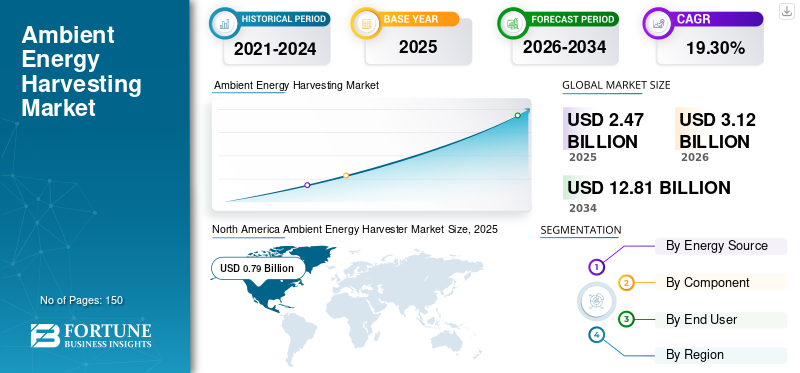
The ambient energy harvester market size was valued at USD 2.47 billion in 2025. The market is projected to grow from USD 3.12 billion in 2026 to USD 12.81 billion by 2034, with a CAGR of 19.30% over the forecast period.
An ambient energy harvester is a device or system designed to capture small amounts of energy naturally present in the surrounding environment and convert it into usable electric power. This energy can come from sources such as light (solar), heat (temperature gradients), mechanical vibrations or motion, and Radio Frequency (RF) signals. The harvested energy is typically used to power low-energy electronic devices, allowing continuous operation and reduce reliance on traditional or with significantly reduced battery usage. These systems are widely applied in wireless sensor networks, Internet of Things (IoT) devices, wearable electronics, industrial monitoring, and smart infrastructure, where long-term, maintenance-free, and self-sustaining power solutions are significant.
The growth of the market is primarily driven by the rapid expansion of Internet of Things (IoT) and wireless sensor networks, which require reliable, low-maintenance power sources for large-scale deployments. Increasing demand for battery-free or low-maintenance devices, mostly in industrial monitoring, smart buildings, and healthcare applications, is further accelerating adoption. Advancements in low-power electronics and energy-efficient components, such as PMICs and ultra-low-power sensors, are making energy harvesting solutions more viable and cost-effective.
Leading companies in the market include Texas Instruments, Analog Devices Inc., STMicroelectronics, EnOcean GmbH, and e-peas SA, each contributing significantly to technological advancement and commercialization of energy harvesting solutions. Their efforts are centered on developing highly efficient power management solutions, miniaturized components, and integrated systems that can reliably capture and utilize energy from multiple ambient sources such as light, heat, vibration, and RF signals. These companies are also investing in research and development to enhance performance in low-energy environments, while supporting the growing ecosystem of IoT, wireless sensor networks, and smart infrastructure.
Download Free sample to learn more about this report.
Ambient Energy Harvester Market Trends
Rise of Battery-Free and Self-Powered Systems is Emerging Market Trend
A prominent trend in the market is the growing shift toward battery-free and self-powered electronic systems across various applications. As industries increasingly adopt connected devices, there is a strong emphasis on reducing dependency on conventional batteries, which require periodic replacement and maintenance. This is particularly evident in smart buildings and industrial automation, where large-scale deployments demand long-term reliability. For instance, EnOcean has reported deployment of its battery-free wireless technology in over 1 million buildings worldwide, highlighting real-world adoption of self-powered systems. Additionally, organizations such as the International Energy Agency (IEA) emphasize the need to reduce electronic waste, which is estimated to exceed 50 million metric tons annually, further encouraging battery-less solutions. This trend is driving manufacturers to integrate energy harvesting directly into devices, enabling autonomous operation while aligning with sustainability goals and reducing lifecycle maintenance costs.
MARKET DYNAMICS
Market Drivers
Download Free sample to learn more about this report.
Increasing Adoption of IoT and Connected Devices to Push Market Growth
The rapid adoption of Internet of Things (IoT) technologies is a key driver for the ambient energy harvester market growth, as it creates strong demand for reliable and maintenance-free power solutions. IoT ecosystems rely on distributed sensor networks deployed across industries such as manufacturing, healthcare, and infrastructure. According to the International Data Corporation (IDC), global IoT spending is projected to surpass USD 1 trillion by 2026, reflecting the scale of connected device deployment. These devices often operate in remote or inaccessible environments, where battery replacement is impractical. Energy harvesting enables continuous operation by leveraging ambient energy sources, making it highly suitable for such applications. Furthermore, organizations such as GSMA estimate that a huge number of IoT connections will be active globally within the next decade, reinforcing the need for scalable, low-maintenance power solutions. This widespread adoption of connected systems is significantly accelerating the demand for ambient energy harvesters worldwide.
Market Restraints
Limited and Variable Energy Availability to Limit Market Growth
A major restraint for market growth is the limited and inconsistent availability of ambient energy sources, which can affect the reliability of power generation. Unlike conventional energy sources, ambient energy such as light, heat, or vibration is highly dependent on environmental conditions and may not always be available at sufficient levels. For example, research published by institutions such as MIT and IEEE indicates that typical indoor solar energy harvesting systems generate only a fraction of power compared to outdoor systems, significantly limiting their efficiency. Similarly, RF energy harvesting often produces power in the microwatt range under practical conditions, which restricts its use to ultra-low-power devices. This variability requires additional components such as energy storage systems to ensure continuous operation, increasing system complexity and cost. As a result, these limitations can hinder adoption in applications where consistent and reliable power is crucial.
Market Opportunities
Expansion of Smart Infrastructure and Sustainable Solutions to Create New Growth Avenues
The expansion of smart infrastructure and sustainability initiatives presents significant opportunity for the market. Governments and organizations worldwide are investing heavily in smart cities, intelligent transportation systems, and energy-efficient buildings. According to the United Nations, over 55% of the global population currently lives in urban areas, and this is expected to rise to nearly 70% by 2050, driving demand for smart infrastructure. These environments rely on extensive networks of sensors for monitoring and automation, creating a strong need for maintenance-free power solutions. Energy harvesting technologies can reduce reliance on wiring and batteries, lowering operational costs and environmental impact. Additionally, the European Commission and other regulatory bodies are promoting energy-efficient technologies as part of sustainability goals, further supporting its adoption. As infrastructure becomes more connected and environmentally focused, ambient energy harvesting is well-positioned to play a critical role in enabling scalable and sustainable smart systems.
Market Challenges
Complex System Integration and Design Optimization to Limit Market Growth
One of the key challenges in the market is the complexity involved in integrating energy harvesting systems into compact and efficient electronic devices. Designing systems that can effectively capture, store, and manage energy from variable sources requires careful coordination of multiple components. According to studies published in IEEE journals, inefficiencies in power management and system integration can result in significant energy losses, impacting overall performance. Additionally, integrating energy harvesting modules into miniaturized devices such as wearables or embedded sensors presents constraints related to size, cost, and efficiency. Industry players often need to develop customized solutions tailored to specific applications, which escalates development time and complexity. For instance, integrating energy harvesting into industrial IoT sensors requires balancing durability, environmental conditions, and power requirements. These challenges make it difficult to standardize solutions, slowing widespread adoption and increasing the need for advanced design and engineering expertise.
Segmentation Analysis
By Energy Source
High Energy Output and Easy Integration Leads to Solar Segment Growth
Based on energy source, the market is segmented into solar, vibration & kinetic, thermal, RF energy harvesting, and others.
Solar segment accounted for approximately 44.74% of the market share in 2025. Solar energy harvesting represents the largest and mature segment of the market, driven by its relatively high energy output and ease of integration into both indoor and outdoor applications. Photovoltaic technology is widely used in consumer electronics, smart buildings, and industrial IoT devices due to its cost-effectiveness and reliability. The segment benefits from continuous advancements in low-light and indoor solar cells, enabling operation even in limited lighting conditions. Its strong adoption in Asia Pacific and emerging markets further supports market growth. However, its dependence on light availability and performance variability in indoor environments remain key considerations. Overall, solar continues to dominate due to scalability and technological maturity.
RF energy harvesting segment is growing at a CAGR of 22.37% during the forecast period.
To know how our report can help streamline your business, Speak to Analyst
By Component
Widespread Deployment Across Varied Applications Leads to Transducers Segment Growth
Based on component, the market is segmented into PMICs, energy storage, transducers, and others.
Transducers account for approximately 35.83% of the market share. Transducers constitute the largest share of the market, as they are responsible for converting ambient energy sources such as light, heat, vibration, and RF signals into electrical energy. This segment forms the foundational layer of any energy harvesting system and is hardware-driven. The dominance of transducers is also attributed to its widespread deployment across all applications, including industrial IoT, consumer electronics, and smart infrastructure. Technologies such as photovoltaic cells, piezoelectric materials, and thermoelectric generators are continuously evolving to improve conversion efficiency and adaptability. The high share of this segment reflects its essential role in energy harvesting systems, although the growth is relatively moderate compared to more advanced components such as PMICs.
PMICs is expected to grow at a CAGR of 20.04% during the forecast period.
By End User
Rapid Expansion of E-Commerce Sector to Propel Manufacturing Segment Growth
Based on end user, the market is segmented into transportation, healthcare & medical devices, manufacturing, consumer electronics, building & infrastructure, and others.
Manufacturing segment represented the largest ambient energy harvester market share of around 30.63% in 2025. Manufacturing is the largest end-use segment in the market due to its widespread adoption in industrial IoT and predictive maintenance applications. Energy harvesting is extensively used to power wireless sensor networks that monitor equipment health, vibration, temperature, and other operational parameters. These systems reduce reliance on wired infrastructure and minimize maintenance costs associated with battery replacement. The strong push toward Industry 4.0 and smart factories is further accelerating segment growth, as manufacturers seek scalable and efficient solutions for real-time monitoring and automation. The dominance of this segment reflects the critical need for reliable and maintenance-free power sources in industrial environments.
Healthcare & medical devices segment is the fastest growing segment with a CAGR of 20.72% in the forecast period.
Ambient Energy Harvester Market Regional Outlook
By geography, the market has been studied across North America, Europe, Asia Pacific, Latin America, and the Middle East & Africa.
North America
North America Ambient Energy Harvester Market Size, 2025 (USD Billion)
To get more information on the regional analysis of this market, Download Free sample
North America is the dominant region globally with market valued at USD 0.79 billion in 2025, accounting for approximately 32.07% of the market. This is driven by its advanced technological ecosystem, strong presence of semiconductor companies, and early adoption of IoT and wireless sensor networks. The U.S. dominates the region due to significant investments in industrial automation, smart infrastructure, and healthcare technologies. The region also benefits from strong R&D capabilities and the presence of key players developing PMICs and integrated systems. Additionally, high adoption of smart building technologies and industrial IoT solutions continues to support demand for energy harvesting systems, particularly in applications requiring long-term, maintenance-free operation.
U.S. Ambient Energy Harvester Market
The U.S. market was valued at USD 0.68 billion in 2025 and will reach USD 0.86 billion in 2026. The country leads the market due to strong adoption of industrial IoT, advanced semiconductor capabilities, and early deployment of smart infrastructure. High demand from healthcare, industrial automation, and building automation sectors continues to drive market growth.
Europe
Europe accounted for USD 0.59 billion in 2025, representing approximately 23.92% of global revenues. The region’s growth is largely supported by strong adoption of Industry 4.0 practices, particularly in countries such as Germany, France, and the U.K. Germany leads within the region due to its robust manufacturing base and focus on industrial automation. European Union policies promoting energy efficiency and sustainability are also encouraging the adoption of energy harvesting technologies, especially in smart buildings and infrastructure projects. Additionally, the region has a strong presence of niche technology providers specializing in energy harvesting solutions. The emphasis on reducing carbon emissions and improving energy efficiency continues to drive steady demand across industrial, automotive, and infrastructure sectors.
Germany Ambient Energy Harvester Market
Germany was valued at USD 0.15 billion in 2025 and is estimated to reach USD 0.19 billion by 2026. Germany is a key market in Europe, supported by its strong manufacturing base and Industry 4.0 adoption. High demand from industrial automation and automotive sectors positions it as a leading adopter of vibration and thermal energy harvesting technologies.
U.K. Ambient Energy Harvester Market
The U.K. market was valued at USD 0.088 billion in 2025 and is expected to secure USD 0.11 billion share in 2026. The market is driven by smart building initiatives and increasing adoption of energy-efficient technologies. Government focus on sustainability and digital infrastructure is supporting steady demand for energy harvesting solutions.
Asia Pacific
Asia Pacific market was valued at USD 0.79 billion in 2025, accounting for approximately 32.06% of global revenues. The region is driven by large-scale electronics manufacturing, rapid urbanization, and increasing adoption of IoT technologies in countries such as China, Japan, and India. China leads the region in terms of volume, supported by its strong manufacturing ecosystem and expanding industrial base, while Japan contributes through technological innovation in miniaturized electronics. According to global urbanization trends, the region is witnessing significant infrastructure development, which is boosting demand for smart systems and energy-efficient solutions. Additionally, the growing focus on smart cities and connected devices is accelerating the adoption of energy harvesting technologies, positioning Asia Pacific as a key growth engine for the market.
China Ambient Energy Harvester Market
China remains the dominant contributor in Asia Pacific, reached USD 0.35 billion in 2025 and will be valued at USD 0.45 billion in 2026. China dominates the Asia Pacific market in terms of volume, driven by large-scale electronics manufacturing and rapid industrialization. Growing investments in smart cities and IoT infrastructure are significantly boosting adoption.
India Ambient Energy Harvester Market
India reached at USD 0.15 billion in 2025 and is predicted to be valued at USD 0.18 billion in 2026. India is an emerging market with increasing adoption driven by smart city projects and expanding IoT ecosystem. Growth is supported by rising demand for cost-effective and low-maintenance power solutions in infrastructure and industrial sectors.
Japan Ambient Energy Harvester Market
Japan was valued at USD 0.10 billion in 2025 and will reach USD 0.13 billion in 2026. Japan’s market is characterized by technological innovation, particularly in miniaturized and low-power electronic devices. Strong presence in consumer electronics and advanced R&D supports steady growth in energy harvesting applications.
Latin America
Latin America accounted for USD 0.16 billion in 2025, or approximately 6.42% of global revenues. Countries such as Brazil and Mexico are leading the region, supported by gradual industrialization and increasing adoption of connected technologies. The market in this region is primarily driven by applications in building automation, industrial monitoring, and infrastructure development. While adoption is still in the early stages compared to developed regions, increasing investments in smart infrastructure and energy efficiency are creating new opportunities. Additionally, the need for cost-effective and low-maintenance power solutions in remote and underserved areas is supporting the adoption of energy harvesting systems, particularly in applications where traditional power infrastructure is limited.
Middle East & Africa
Middle East & Africa region was valued at USD 0.14 billion in 2025. Growth in this region is driven by increasing investments in smart city projects, particularly in Gulf Cooperation Council (GCC) countries, and the need for reliable power solutions in remote and harsh environments. Energy harvesting is particularly useful in oil and gas, utilities, and infrastructure monitoring applications, where conventional power supply can be challenging. According to urban development initiatives, several countries in the region are investing heavily in modern infrastructure, which is expected to support future adoption. Although the market is still developing, rising awareness of energy-efficient technologies and sustainability goals is gradually driving demand for ambient energy harvesting solutions.
GCC Ambient Energy Harvester Market
The GCC market which was valued at USD 0.062 billion in 2025 and will reach USD 0.078 billion in 2026. The GCC market is driven by investments in smart cities and infrastructure projects, along with demand from oil and gas applications. Energy harvesting is particularly valuable for remote monitoring in harsh environmental conditions.
COMPETITIVE LANDSCAPE
Key Industry Players
Technological Advancement Solutions Provided by Key Players are Booming Market Share for Companies
Leading companies such as Texas Instruments, Analog Devices Inc., STMicroelectronics, EnOcean GmbH, and e-peas SA are collectively driving the advancement of market through a strong focus on innovation, efficiency, and system integration. Their efforts are largely centered on developing ultra-low-power semiconductor solutions and highly efficient power management technologies that can maximize energy capture from minimal and variable ambient sources. These companies are also prioritizing miniaturization and integration, enabling energy harvesting capabilities to be embedded into compact IoT devices, wearables, and wireless sensors. In addition, they are actively supporting the transition toward battery-free and maintenance-free systems by enhancing energy conversion efficiency and improving compatibility across multiple energy sources such as solar, thermal, vibration, and RF.
List of Key Ambient Energy Harvester Companies Profiled
- Texas Instruments (U.S.)
- Analog Devices, Inc. (U.S.)
- STMicroelectronics (Switzerland)
- NXP Semiconductors (Netherlands)
- e-peas SA (Belgium)
- EnOcean GmbH (Germany)
- Mide Technology Corporation (U.S.)
- Cedrat Technologies (France)
- Perpetuum Ltd. (U.K.)
- Laird Connectivity (U.S.)
- Fujitsu Limited (Japan)
- Panasonic Corporation (Japan)
- ABB Ltd. (Switzerland)
- Honeywell International Inc. (U.S.)
- Schneider Electric SE (France)
KEY INDUSTRY DEVELOPMENTS
- February 2025: EnOcean expanded its battery-free wireless sensor portfolio, introducing new self-powered switches and sensors for smart buildings. The company also strengthened ecosystem partnerships to accelerate adoption of energy harvesting technologies.
- September 2024: Analog Devices enhanced its portfolio of ultra-low-power power management technologies, improving energy efficiency in low and variable energy environments. These advancements support wearable devices and industrial IoT systems.
- March 2024: e-peas introduced advanced energy harvesting PMIC solutions designed to support multiple ambient sources including solar, thermal, and RF. These solutions enhance efficiency for ultra-low-power IoT devices and enable more reliable battery-free operation in smart buildings and industrial applications.
- November 2023: Texas Instruments advanced its energy harvesting PMIC technologies, focusing on improved efficiency and integration for solar and RF-based harvesting systems, targeting industrial automation and remote sensing applications.
- June 2023: STMicroelectronics expanded its integrated energy harvesting solutions, combining sensing, processing, and power management capabilities. These developments were aimed at enabling compact, self-powered IoT nodes for industrial and infrastructure monitoring.
REPORT COVERAGE
The report provides a comprehensive analysis of the market, focusing on key aspects such as leading companies, product processes, and Porter’s Five Forces. Additionally, the report provides valuable insights into market trends and highlights key industry developments. In addition to the factors mentioned above, the report also encompasses several factors that contributed to the market's growth in recent years.
Request for Customization to gain extensive market insights.
REPORT SCOPE & SEGMENTATION
| ATTRIBUTE | DETAILS |
| Study Period | 2021-2034 |
| Base Year | 2025 |
| Estimated Year | 2026 |
| Forecast Period | 2026-2034 |
| Historical Period | 2021-2024 |
| Growth Rate | CAGR of 19.30% from 2026 to 2034 |
| Unit | Value (USD Billion) |
|
Segmentation |
By Energy Source
|
|
By Component
|
|
|
By End User
|
|
|
By Region
|
Frequently Asked Questions
According to Fortune Business Insights, the global market value stood at USD 2.47 billion in 2025 and is projected to reach USD 12.81 billion by 2034.
In 2025, the North America market value stood at USD 0.79 billion.
The market is expected to exhibit a CAGR of 19.30% during the forecast period of 2026-2034.
By energy source, solar segment is expected to lead the market.
Increasing adoption of IoT and connected devices are driving market expansion.
Texas Instruments, Analog Devices Inc., STMicroelectronics, EnOcean GmbH, and e-peas SA are the major players in the global market.
North America dominated the market in 2025.



- 2021-2034
- 2025
- 2021-2024
- 150
Get 20% Free Customization
Expand Regional and Country Coverage, Segments Analysis, Company Profiles, Competitive Benchmarking, and End-user Insights.



















-
US +1 833 909 2966 ( Toll Free )
-
Get In Touch With Us